Wednesday, 9 March 2011
9 March 2011
Emily is very resistant to writing letters or even drawing. I wish we knew for sure our medium term future, because if we are staying here she needs to be in a more structured pre-school environment. She's into magic heavily, perhaps influenced by our recent discovery of Ben and Holly's Little Kingdom, and the acquisition of the Princess and the Wizard, her current favourite book. She has such an odd accent at times, and some words are positively yokel in pronunciation, eg. oys (eyes) and insoide (inside). I know I grew up in Somerset but I don't think that is coming from me. In fact, to mollify Nick I often stress a slightly northern pronunciation, such as trying not to elongate the 'a' in grass, bath etc. Her teachers mainly speak in an Americanised accent so where can she be picking it up? Ballet went very well; even after so few classes she seems to be really picking the moves up.

Monday, 7 March 2011
7 March 2011
We were up early as we had booked on a 2 hour boat trip. While packing, Nick got a call from the operator, asking us to go as soon as possible as the forecast was for increasing wind and waves, so we ended up getting in a flap. The bad vibes were compounded when we went to the wrong car park. After emerging from five floors of the exit ramp because the store below the car park was still closed, a man ushered us urgently to the pier. We found a medium sized boat waiting for us, with a 50-strong contingent of teenaged schoolgirls aboard. As soon as we went on deck there was a mass chorus of 'kawaii' (cute), and much giggling behind hands.


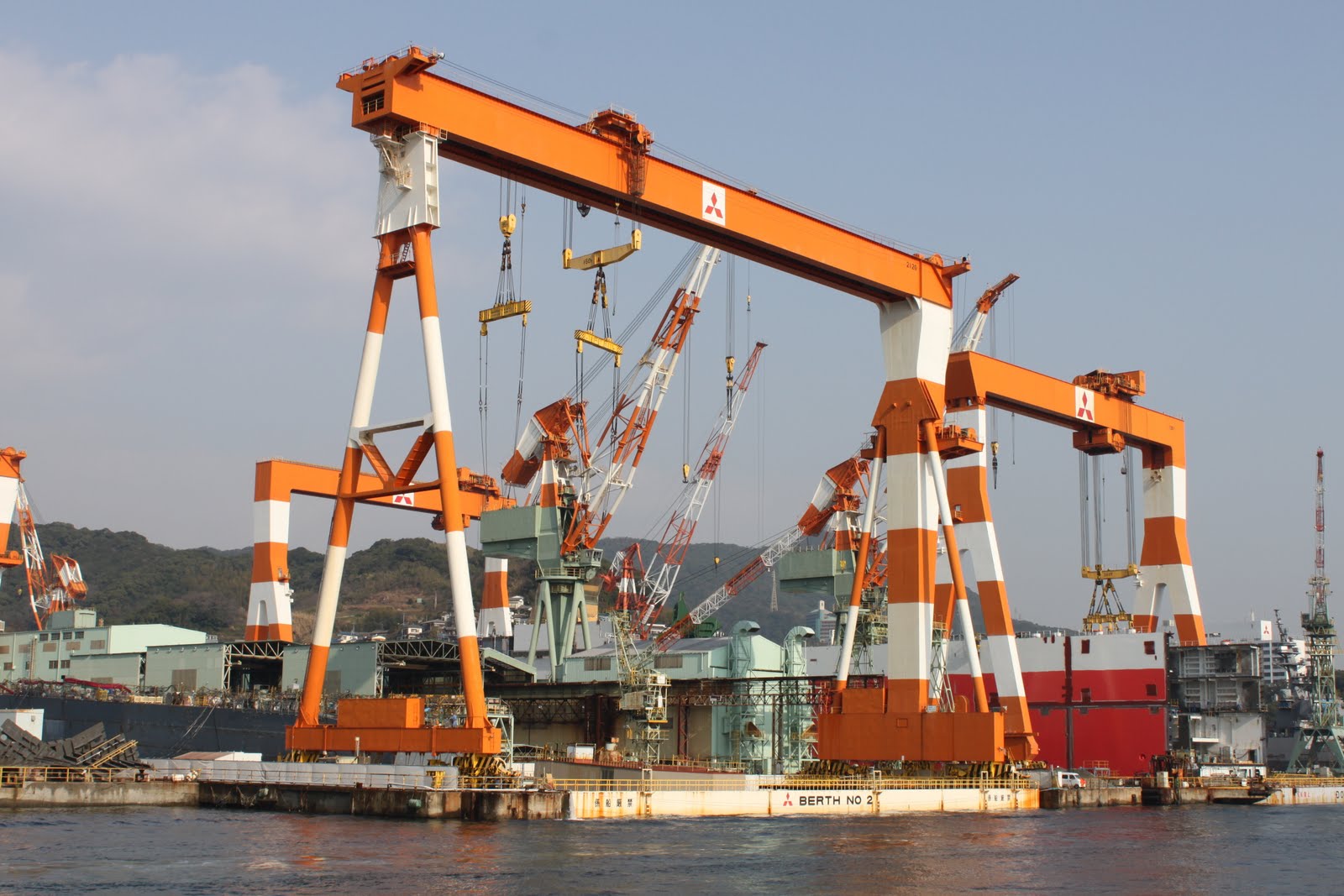
It was calm enough in the harbour area and we enjoyed looking at the Mitsubishi shipyards and waterfront area of the city.

After we passed under the large Megami Bridge the sea became gradually choppier.

We passed dozens of islets until we reached the turnaround point and main interest of the trip, Gunkanjima (warboat island). This Japanese version of Alcatraz did indeed resemble a naval vessel in profile, though the former occupants were actually there to mine coal. The hideous concrete buildings were actually once apartments, a school, a hospital and even a cinema.

In the lee of the island it was more or less flat but out in the open sea we were being rolled about quite a bit, and I don't have the best sea-legs at the best of times. Actually I ended up nodding off in the indoor lower deck, while Nick and Emily sat outside. They saw a jetfoil boat whizzing past at one point, similar to the one we took when we went to Oshima.

Amazingly, we managed to lose the car park ticket twice. Nick mislaid it first - it had fallen down the crease between seat and chairback. After he had set off to speak to the customer services people in the store, I called him back as I had found it, but by the time he got to the car I had lost it again. None of that helped the stress levels, but luckily the drive to the airport was quicker than expected, which was just as well as I had misremembered the flight time by 20 minutes. In the end the departure back to Tokyo was delayed by nearly half an hour though.
6 March 2011
We passed over the disappointing breakfast experience in favour of bread rolls and yogurt in our room. It was a rainy day in Nagasaki, but we pressed on with our planned itinerary. First up was Dejima, which was the only foreign enclave allowed during the long period that Japan closed itself off from the world. All that was to be seen now was a pier housing a few shops and restaurants, a pleasant enough place to hang out for a short while but nothing particular to show that it had a special history.


After that we spied a nice looking seaside park and wandered around there, as the rain became gradually heavier. As usual we had a disagreement about where to eat, but this time we finished up 'dining' in Starbucks as it was just too wet to spend much time traipsing about looking for a Japanese restaurant that I approved of.
Ten minutes up the road was the start of a string of temples and shrines spread out along the hillside. The first, Sofukuji, was built in the Ming style and had a rather attractive gate.


Up some stone-flagged steps was the main complex, where we could furl our umbrellas a while. Emily took a dislike to it because there was one room full of stern stone figures, including the one she calls the ghost buddha (actually a bodhisattva, Pindaro).

After missing our way a couple of times we made our way down the street and to the next temple, Daionji, pausing on the way to admire Hosshinji bell, cast in 1438. We found a heavenly-scented plum tree in a graveyard along the road.


After seeing a number of sights in the downpour we felt that Emily had done very well staying on her feet and decided to search out a cafe for some respite from the rain. This we found in a long covered arcade. Nearby was the Nakashima river, spanned by no fewer than ten 17th century bridges (most of which are modern reconstructions of originals that had been washed away in floods). Most famous is Meganebashi: Spectacles Bridge; so called because the bridge and its reflection look like a pair of glasses.

Emily was happy exploring along the riverside despite the continuing deluge, but we'd had enough and wanted to get back to the shelter of the mall. We spent a good half hour looking for somewhere to have an early dinner but in the end we turned to the guide book and I am so glad that we did. The place we chose, Ginnabe, was fantastic and I would happily have eaten there all three days if we had found it sooner. It was a Japanese restaurant with all the usual favourites, but done very well, and some with a bit of a modern twist. We over-ordered but really enjoyed the half dozen or so dishes. It had a lovely ambience, with wooden decks and footwells for seating, each table divided by a transparent hanging screen, to Emily's delight.
We got back to the hotel fairly early and once Emily was asleep we had time to relax and enjoy the night view for a couple of hours.


5 March 2011
For once the forecast was spot on as we got great weather for our day trip to Shimabara and its very active volcano cluster, Unzen-dake. We didn't linger long over our very poor breakfast and were soon away; it took a little over an hour to drive over the hills surrounding Nagasaki, and around the coast road. The bulk of the mountains loomed across the curve of the bay.


The final quarter hour of the drive ascended a narrow switchback road and then we took a toll route and climbed higher again. From a roadside panoramic spot we drank in stunning views over hundreds of islands, and panning round, over extensive lavaflows and up to Heisei Shinzan.


Just 20 years ago a 250 metre addition to the existing volcano was pushed up, accompanied by violent rending of the earth and massive lava outpourings. It was named after the current emperor's reign.
Though it was very cold in the shade, we found a sheltered and sunny spot and ate a picnic outside the ropeway station a little further on from the viewpoint. The gondola took us up a short but steep cable to a station planted on one of a ring of older lava stack hills ringing the central cone.

We spent more than an hour pottering around up there; there was even a scattering of snow in north-facing nooks and crannies. Nick found some amazing trees with wind-sculpted ice-crusts thawing in the sun.

On the return drive we stopped off further down the mountain to wander around the town of Unzen Spa, a sulphurous, steamy hot springs resort. We strolled around the pathways wending among the bubbling mudpools and steamy geysers. Several centuries ago a bunch of Christians were put to death in the boiling 'hells' - I could not imagine dying in such a gruesome and slow manner. Emily thought the persistent pong was very amusing at first, but you quickly become accustomed to the stench.


Back down at sea level we ended the day at a beach we'd spotted on the way. Unfortunately Emily had fallen asleep just before we pulled into the car park facing the sea. We took it in turns to stay in the car with her while the other strolled on the sand. By the time she woke the sun was just about to slip below the distant hills, so we only managed a quick ten minute walk on the beach before it became too dark.


In any case it was bitterly cold by then. We decided to eat somewhere on the way back to the hotel and in the end we dined rather well at a cheap Japanese family restaurant chain, Joyfull, in a small town near the beach. I suspect that they probably see foreigners there only once or twice a year, if that, judging by the amount of attention we got in the packed 200+ seater eatery. The waiting staff were ridiculously obsequious (to everyone, not just us), bowing low after delivering the food to the table.
By the time we got back to the hotel it was nearly 9pm. A child's yukata had been put out for Emily and she tried it on, though it was far too long. We let her play briefly and then it was time for her to sleep. Nick and I sat by the window and enjoyed the pretty night view.
4 March 2011
The alarm jarred us awake at a painful 5am. Luckily Emily woke straight away and as soon as we were showered and dressed we headed for the airport. The pre-dawn air was pleasantly cool and further helped to revive us. As we rode the busy monorail to Haneda the sun was just climbing above the horizon and it promised to be a bright day. We got lucky with our seats on the plane as we had perfect views of Fuji-san; the flight path was practically over the crater and even through the snow cover I could see the zigzag path I had trudged up on that wet and windy night last July.

All along the route we could pick out places we recognised: Enoshima, Nagoya, the Inland Sea with its couple of thousand islets (despite its name, it is actually open to the Pacific at either end).
We landed at Nagasaki airport on its artificial island around 10am and went to collect our little hire car. Emily slept on the 45 minute drive to the hotel, which was perched high up above the harbour area. We parked and straight away got on a bus into the city, then changed onto a tram for a short way, to the old foreign district on the south side of town. The attractions here were Oranda Zaka (Dutch slopes) and the Glover garden.

The city has a long history of foreign traders from China and Europe, and during the 200 years of self-imposed exile from the rest of the world, Nagasaki was the site of the only trading outpost in the whole of Japan. The island of Dejima was reserved for Dutch traders and their movements were strictly controlled to ensure that the taint of Christianity was contained.
Though a tourist area, when we needed lunch we found relatively few options, and it was stressful trying to find somewhere all three of us could eat adequately. I didn't fancy the city's speciality, champon: noodles in a broth with various bits of unappetising seafood and a few overcooked vegetables. We ended up eating just about passable food in a nearby hotel. After lunch we strolled up the western-style slopes above the hotel, with their stone-flagged roads and houses with wide verandahs, which I thought looked more colonial than European.

There was one old house free to look around, which we did. Emily loved the Victorian outfits and tried on a hat.

We had refreshments out in the small garden, under a magnolia groaning with buds.

From there, we went to a Confuscian temple, but the entry fee put us off, and in any case it was fairly modern and we had seen much better temples in Taiwan.

Next stop was the Oura Catholic church,

the oldest in Japan, which is in the lee of the Glover garden, which covers the whole steep hillside above. Here we found several 150 year old houses formerly belonging to British and Scottish pioneers, who brought valuable technologies and trade to Japan when it opened up around 1858 (shipbuilding, railways, beer, tea trading). All buildings were open to browse around and some were still furnished and with explanations in English too.


The garden was pleasant and in places large pieces of coral had been used to good effect. There were good views around the harbour and surrounding hills.

On the way out we passed a stall with a cute Hello Kitty wielding a set of numchaka (ninja weapons).

Emily seemed rather floppy and was not breathing well (she has been snotty and coughing for weeks now), so when it was time to leave I carried her in the carrier. On the tram she was trying to sleep but could not get comfortable. It was rush hour so we could not get on the connecting tram and decided to walk to the main station, where we hoped to eat an early dinner. She seemed very distressed so in the end Nick carried her in his arms, but we realised it was quite a way so jumped on a bus. By the time we got there we had become concerned about her as her breathing was coming in little gasps sometimes and she felt a bit feverish. We abandoned our meal plans and got in a taxi, deciding we had better take her to see a doctor. Amazingly, we were told at the hospital that it was not possible to see a paediatrician for another hour, and to see him we would have to go to another clinic across town. In Japan, all doctors specialise; there seems to be no crossover from one discipline to another, and there is no GP system. While we waited, a nurse took Emily's temperature and it was 39.3C so we were relieved when 8pm approached and we were able to take another taxi to the clinic. The doctor listened to her chest and said it sounded alright. In order to check for flu, he took a nasal swab and that made her yell as it was thrust quite a long way up. After quarter of an hour they told us that had checked out OK, so he prescribed several powders and patches and said we should give her the Calpol we had at the hotel too. While waiting she had perked up a bit though still hot, and was even talking to the nurses. A final taxi got us back to the hotel at 9pm. Emily was suddenly hungry so we gave her some snacks and then settled her on her futon. Apart from 20 minutes in the car she had been awake for 17 hours by then. After she had dropped off we sat by the huge picture window and looked at the lights of the city arranged around the harbour and up into the surrounding hills (the so-called '10 million dollar view'!).
